Sunday, April 18, 2010

Saddlebags as Camera Bags?

Zimbale Camera Insert in a Carradice Barley
For the past two years, I have been using either my Carradice Barley or Zimbale 7L saddlebags, with the padded Zimbale insert shown here, as camera bags. This setup is convenient, secure and fits up to three full sized (SLR or medium format) cameras. The side pockets are great for storing film, a flash unit or other accessories.


But I am also ever on the lookout for a much smaller bag that will accommodate a single camera equally well without the extra bulk. The ideal bag for this would be just large enough to swallow a DSLR with a zoom lens attached, but no larger - so that it's tucked in behind the saddle without the sides sticking out. It would be fantastic if the bag had a padded insert, but not a dealbreaker if it does not; I can make my own. Finally, I would like for the bag to have the look and feel of a classic saddlebag: earth-tone canvas, that sort of thing.


VO Croissant Bag

A bag such at the Velo Orange Croissant, or the Berthoud it is based on, would be perfect for the job if just a tad larger. Unfortunately they do not quite fit my camera comfortably. It looks like the similarly shaped Acorn and Zimbale bags are slightly bigger, but I am not certain they are sufficient either.


Surly Cross Check, Rockport MA

After seeing the dimensions of the Carradice Zipped Roll, I thought that it would be large enough. But while the bag is large enough in itself, the opening is quite narrow and I cannot get my camera through. The Zipped Roll has now become the Co-Habitant's handlebar bag.


United Pedal Saddlebags, via Bicycle Habitat

This United Pedal saddlebag I spotted at the New Amsterdam bike show had the same issue - the bag itself being the perfect size, but the opening too small to fit a full-sized camera through.


A.T.'s Raleigh DL-1: Brooks B66

It occurs to me that a traditional Roadster saddlebag design could work as well - only made of lighter fabric, so as to make sense on a roadbike.


In this era of small-scale bicycle bag manufacturers, I think it would be a great idea for someone to design the perfect single-camera saddlebag. So many cyclists are also photographers and would love to carry an SLR on their roadbikes without having to mount an expedition-sized saddlebag every time.


If you carry a full sized camera in your saddlebag, what is your setup?

FOTR Rally


Saturday, April 17, 2010

Tombstone Tuesday :: Rest in Peace

On the campus of Saint Mary-of-the-Woods College near Terre Haute, Indiana
Winter of 1981I didn't read the other side of the stones so don't know who is buried there.Copyright © 1981/.. by Rebeckah R. Wiseman

Wednesday, April 14, 2010

Allensworth State Historical Park

After leaving Death Valley on March 27th I had decided to continue west to the coast of California, still seeking warmer weather. Along the way, I saw a sign for the Colonel Allensworth State Historical Park, which is located off of Interstate 5 northwest of Bakersfield, California. I went there not knowing what it was, only hoping that it had a campground.

The entrance welcomed me and I knew that I was in a very special place. Thankfully, it also had a campground!

According to a brochure that I picked up, the town of Allensworth was established in August 1908 by Colonel Allen Allensworth and four other settlers. It was the first settlement in California founded, financed and governed by African Americans. Their dream was to develop a thriving community based on the belief in programs that allowed blacks to help themselves create better lives. By 1910 Allensworth’s success was the focus of many national newspaper articles praising the town and its inhabitants.

Born into slavery and educated illegally, Allensworth ran off and joined the Army during the Civil War. He became one of the Army's first Black chaplains and at his retirement in 1906, he was the highest ranking African American commissioned officer in the United States military.

The townsite was purchased in 1974 by the California State Parks. Some of the homes and buildings have been restored while others are reconstructions.

The Stockett House and outbuildings.

The First Baptist Church.

Each building has a sign which provides a brief history.

The prefabricated house of Colonel Allensworth, delivered by railroad and assembled in 1911.

Additional photographs can be found on this page of the Allensworth Historical Park website. A biography of Colonel Allensworth can be found on Wikipedia.

Monday, April 12, 2010

Birthday Trip


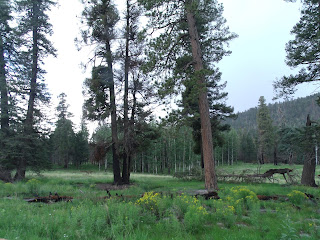
We decided to take a driveup to our favorite place yesterday, the Jemez Mountains. It was to be part of my birthday present. We stopped at several places we frequently stop at. It had rained the day before and everything seemed fresh and clean with the smell of pine, juniper, and wet dirt.


We stopped at the Forest Service Office where this huge cottonwood tree is, and bought our yearly permit to cut firewood.


We were interested in seeing the area where the fire had gone through in June on Thompson Ridge where we had heard it had jumped the paved road that goes between Jemez Springs and Los Alamos, New Mexico. We saw these gates and signs at most of the places where you can get off the road. One sign said Closed to Public Use with a sign beside of it that read Please Close the Gate. I know the yellow sign had been there before but it looked funny.


We could see where the fire had burned most of the trees on the hilltops but left a lot of the small grassy areas. This pretty little ranch was lucky, as it came almost to their door.


You can see the burnt trees on this ridge.


But we did see lots more wildflowers than we expected.


Wednesday, April 7, 2010

Snorkeling at Bahia Honda State Park

The older kids drove down to join us today, and we headed over to Bahia Honda to do some snorkeling. We had a big rain storm all day yesterday so it was a bit chilly and the water was too cloudy to see anything. We had fun anyways. We were there when the sun was beginning to set. As glorious as I think the beach is, I think being there at sunrise and sunset makes it a million times more glorious.


The kids waded out in the water first and I could tell by their expressions that the water was cold. Once they got out there, they had fun. Here they are laughing at who knows what. It doesn't even matter what, because when I see my kids laughing-all is right with my world.


I am always fascinated by the birds at the beach. It's hard not to want to snap a million pictures of them!


I'm more fascinated by this though. This is what makes my heart sing. I love these people!


They are laughing again. This time I know what they are laughing at though.


Dad is doing his duck walk into the water. It's the simple things in life that make our day. What can I say? We are easily entertained in this family.


Aren't they beautiful? Even if they are using their dad as a source of entertainment, they are really beautiful!


Life is good! Living it in Sunny Florida!


Tuesday, April 6, 2010

Reaching for Water

Moser 300Spending lots of time on the roadbike has improved my speed and endurance more than I ever thought possible. Unfortunately, my bike handling skills are lagging so far behind that the gap is becoming almost comical.

What's causing some frustration at the moment, is that I can't drink water on the bike while in motion. Other cyclists will nonchalantly remove their water bottle from the cage without reducing speed, drink while continuing to cycle as if this were the most natural thing in the world, then replace the bottle in the cage and keep going as if it never happened. For me this maneuver is impossible to execute; I need to stop the bike in order to drink.

Prior to now this was never a problem. For the most part I cycled alone, and if I needed a drink I simply stopped the bike any time I felt like it. And the paceline rides I went on were only 20 miles, plus our stops at intersections were sufficient to sneak a quick guzzle. But now that I am going on longer rides and with groups of people, I am finding it more difficult to manage my water intake. I need to learn to drink without stopping the bike!

It's just so sad, because I've been practicing the water thing since summer, but progressing at a snail's pace. I can now grab the bottle with my left hand, but the bike jerks wildly when I attempt to yank it out of the cage. And if I do pull it out, what on earth will I do with it? Should I need to turn or stop the bike suddenly, will I be able to do it with one hand holding a bottle? Panic! Panic! Swerve! Panic! Yes, I am really that neurotic.

It doesn't help matters that I am extremely resistant to being taught. "No, really! If I could do it, so can you. Look, I'll teach you." Yeah... Suffice to say, I've never met a well-meaning cyclist whom I couldn't frustratewith my inability to learn technique. So, for now I'm stuck drinking water at stops and gazing in awe at those who can drink while cycling. Maybe some day I will read this post and laugh. Till then, I can only resume my snail's progress.