Saturday, July 18, 2015

End of the Year Pickleball Tournament

Last week Nathan announced to me that he was going to host a pickleball tournament. I know the other wives out there will understand me when I say what that really meant was *we* were going to do a pickleball tournament. I'm so glad he did decide to do this, because it was great fun for us.


We had a great turnout! After a week full of a huge pickleball crowd, we were a little concerned we'd have so many players that it would take all day to finish. Instead we had enough people to do both a men's and women's tournament and it lasted a decent amount of time, without being all day long.


Here are the players:


Some of the action, starting with Ken and Austin. Ken always has that great smile on his face:


Regal Faye with Kim. This week is the first I've met Kim. She is a hoot. She makes the game so much more fun!


Here is Kim with Diane. Diane is a fellow South Floridian and is so cool. And she rocks at pickleball!


I've just met Kristie since we've been here too. She was on a hot streak today!


Me, and given the direction that it appears the ball is moving, I'm guessing it was not a great hit. I still get so intimidated and feel sorry for other people that they are stuck with me as their partner. And the only reason I am sharing that is because I want to give some praise to the other women that play. They are so gracious and sooooo encouraging to me. I appreciate them so much!


Look at that concentration:


Meet Donna and Barbara, who are both awesome players. And both so incredibly sweet and encouraging.


Here is another sweetheart Sheri, and lean mean winning machine Sally. Not that Sally isn't sweet, but she plays to win! I think that's the only shot I have of Sally. The rest are probably just a blur!


Wait a minute, I do have more of Sally. And here you can see the elegant Karen on the other side:


Karen looks dainty, but she can play a mean game!


Sitting on the sidelines:


You'll have to go to Austin's blog to see the men's games because I was too busy watching the women to tell you much detail about the men.

Winners: Sallie-1st, Diane-2nd and Barbara-3rd:


Mike-1st, Austin-3rd and Dave-2nd:


Way to go winners and everyone else that played. You made it tons of fun for us. We hope you had fun too!


You can see the rest of our pictures here: Pickleball Tournament

Friday, July 17, 2015

Weight? All it takes in money! Dynafit ski porn.....


By comparison Liposuction might be cheaper! I' bet therewould never be as much satisfaction though!


Race parts for the Porscheor the Cervelo ( or just the frames of either to get started) are light in weight and expensive. Also known to have a short life span when used as intended.


My first dedicated "lwt" ski system was a BD Prime, Dynafit Speed bindings and a pair of Fisher Asymmetrical ski in a "stiff" version and 178cms. Even what I don't own now of that kit I'd bet is still going strong.


My favorite system recentlyas a "lwt" ski system was a TLT Mtn (shell is lighter than the P version) with the lighter foam TF liner,DynafitLow Tech Race bindings with a steel spring (no Ti) and a 167cm Broad Peak ski.


Which is a really fun all mountain rig. Anything I can ski with in reason, I can ski on that set up.


Likely pushing my skills this winterI have recently dropped another 20.35 oz PER foot with new gear!


All Dynafit. Same Low Tech Race bindings. All 115g of them


NewEVO PDGboots and the shortest ski but not the skinniest ski I have been on.....are these Snow Blades?


The Dynafit PDG ski, selected over some other -800g skiis for the added durability I hope. A drop of 8oz per boot froma stripped TLT5 Mtn and no tongue. The skis drop 12.25oz.A full 1.25 # per foot. 2.5# (1134g) total weightdrop off the feet. Or like dropping 17.5# off my back.


A tough diet and more exercise would becheaper yet! Just no serious weight to be lost from my feet short of beginning tochop off mytoes :)


More on why the weight on your feet is important.


http://coldthistle.blogspot.com//05/the-weight-on-your-feet.html


Short version of Eric's research?


"At a vertical speed of 16m/min for example, with the TLTs my HR would be around
180. With the Evos at the same speed, HR is around 145."


That HR drop is is huge.

Really interested in seeing just what I can ski year around on our maritime snow pack with these kind of dimensions:


Length:161
Weight (g):800
Sidecut:99-65-80
Radius:25.5/20


It is a rig I have wanted for a while now but could never justify the expense. Really looking forward to skiing them and then writing about the experience. And not getting rid of the TLT and Broad Peak combo just yet. Although I would really like a new pair of the Nanga Parbat ski @ 1000g. per pair. Thatwould be a setup I would really like to try for longer mid winter tours.


Back to the Weight? I could have gone lighter and spent more money. But at some point a 13# Cervelo is wasted on me. Same deal here.....couple of grams isn't going to matter too much for me. And ifit is does? I'll just pass on, or pass, something :)

Spagetti or gallstone?? What do you think a gallstone might weight?


Eddie Bauer BC MicroTherm Down Jacket


BC Micro Therm Down Jacket with a Patagonia Knifeblade soft shell and R1under it @ -18C, Canada Rockies.


If you look at Eddie Bauer's advertising the First Ascent Hyalite Jacket gets some serious play as THE technical "climbing jacket" in their speciality line. On the other hand I couldn't wait to get rid of mine and exchange it for something I might actually use skiing and as a second thought climbing. No stretch that I could discern in the FA Hyalite compared to a Gamma MX for example and no warmer. I have any number of state of the art garments with synthetic and down insulation to chose from. Getting me into an unproven garment to ice climb in is difficult. Getting me into one made of down is even more difficult.


Adding a water proof and breathable shell to a light weight down insulated piece makes a lot of sense. Even more so if you value light weight warmth over the ability to get it dried out and usable again if you are going to be working hard in the same jacket.


I climbed some in Hyalite Canyon using a Patagonia Down full zip Hooded Sweater last winter and loved it right up till it really started snowing hard and I was breaking trail in 4 feet of snow. I stayed warm but the jacket got wet and lost a lot of its insulation. Lesson relearned for the umpteenth time.


I am not a sweat hog. I don't sweat any more or any less than the rest of my climbing partners generally. My adventures arebest equippedwith very breathable and really light weight upper body clothing forwalking into winter climbs. Being able to change out to at least a dry top and then layer up for the climbing in generally mandatory if I want to be comfortable. The last layer will seldom get worn but is generallysome sort of "belay jacket". It's warmth will depend on the temps and moisture involved.


Our last trip to Canada I reverted from my tried and true climbing garment combos and went backwards in some sense to the more durable "soft shell" uppers as an action suit topover and R1 or a Merinowool version of the same hoodyand the required "belay jacket" over all of itto keep me warm once I stopped.


The combo is really a little heavier than it needs to be. But it is a well proven combo and is only three layers.


This trip one of the jackets I use exclusively for belay duty and climbing whilecold was the BC Micro Therm. I even used it on a couple of short approaches just to see how wet I could get it and still dry it out why climbing. Much to my surprise I even liked climbing technical ground in the Micro Therm when I was pretty chilled.


The hood was one reason. Its pattern is intentionally cut prettybig and easily fits over my helmet choices. The other is the sleeve size/length and being able to pull the Velcro cuff tabs and pull the jacket sleeves up past my elbows.


Not something that I could ever do previous to the chemo diet. But the sleeves fit a lot better (bigger) now and allow one to vent some serious heat if you can pull up the sleeves in your size. The other feature I really like is both side pockets are vertical vents straight to the body's core. Unzip the pockets...from the top or the bottom and you can work pretty hard in this jacket and still not over heat. I really like the simple design features and how well they work. Make sure you aren't going to dump your pocket contents though!


As far as I can tell the shell material, which is water proof and breathable 2-LAYER SHELL called

WeatherEdge® Pro, 1.7 oz 12-denier fabric with StormRepel® DWR finish; rated to 20K/20K" really is water proof. And no question it breathes very well from my testing as I could always get the down dried out on the belays from my own body heat. The long sleeves, the hood and the pocket ventsare easy to notice in use. It is a very good mid weigh piece of insulation and physically lwt weight belay jacket. My XL weighs in at 1# 5 oz. May be even a better cold weather ski jacket on the lifts or side country compared to many others jackets available and easily the best of the EB ski specific jackets imo.


It also comes in a women's specific version which I hear gets high ranks on fit and warmth as well.

No question the women's colors options are better!


Here is more of theEB spiel:


WATERPROOF/BREATHABLE 2-LAYER SHELL


WeatherEdge® Pro, 1.7 oz 12-denier fabric with StormRepel® DWR finish; rated to 20K/20K


800 FILL PREMIUM EUROPEAN GOOSE DOWN

Down-packed micro-baffles keep you warm with minimal weight and bulk


DUAL-FUNCTION CHEST POCKETS

Provide storage and double as heat-dumping core vents


INTEGRATED HOOD

Fits easily over a ski or climbing helmet


WEATHER-SEALED ZIPPERS AND CORDED PULLS

Eliminate need for flaps; more durable, slide more smoothly and make it easier to grab with gloves on


ERGONOMIC POCKETS AND ARTICULATED ELBOWS

Harness and pack compatible; facilitate easy movement


LOW-PROFILE CUFFS AND 1 INCH LONGER

Adjust for snug fit; provides more coverage to keep you warmer


SIZED A BIT MORE GENEROUSLY

Looser fit provides more room for layering; works for a wider range of body types


CARE INSTRUCTIONS

Machine wash

100% nylon waterproof/breathable 20K/20K shell; 800-fill down insulation

Center back length: Reg. 29 1/2", Tall 31 1/2"

Weight: 1 lb., 3.54 oz. (1 lb., 5oz. or 595g and 2.5" of loft for my XL)


Louise Falls photo courtesy of http://www.rafalandronowski.com/


After all I have a closet full of "real" mid weight climbing specific jackets. This one is a good fine to add to that list. A decent price (on sale) for a water proof and lightly insulated down jacket. One that I have used a good bit now and will again.


EB sez:


"Combining the microchannel construction of the MicroTherm™ Down Shirt into the lining of this fully waterproof and breathable shell rated to 20K/20K, we’ve built a warm, insulated jacket that is lighter than many non-insulated shells on the market. This jacket is built to be the minimalist, lightweight piece that our First Ascent guide team requires in the most challenging environments where every ounce counts. Highly packable. Two large cross-body vents double as pockets. Harness friendly design. Now one inch longer and sized a bit larger through the torso to provide more room for layering and fit more body types. Across the board, this piece was the alpine guides’ personal favorite, hands down."


http://www.skinet.com/skiing/photo-gallery/shell-games


http://www.eddiebauer.com/catalog/product.jsp?ensembleId=40146&oessoa=6046151&cm_mmc=CSE-_-Google%20Product%20Search-_-First%20Ascent%7CMen%27s%20First%20Ascent%20Jackets_and_Vests-_-1020706&CAWELAID=941026515


The video covers it all again:


Thursday, July 16, 2015

Sunday, July 12, 2015

Bicycles and Curb Appeal

By the RiverOne aspect of a bicycle that usually gets omitted from reviews, but I feel is nonetheless important, is "curb appeal" - how noticeable or attractive it is to passers-by (who are not usually bicycle aficionados) at first glance. I've had bicycles in my possession that, while considered excellent and gorgeous by those who know about bikes, are virtually invisible to "normal" people. And then there are bicycles that barely allow me to make it down the street without strangers asking about them.

While it may seem like a superficial thing to care about, the "curb appeal" factor can be important from several perspectives. From the manufacturer's and retailer's point of view, bicycles that are appealing even to those who are not into bikes have the potential to draw in new customers - who may then grow to become serious cycling enthusiasts as a result of the initial lure. From the customer's point a view, a bicycle that is admired by others in their community can enhance their feelings of satisfaction with the purchase and can even result in their riding more often. Even from the point of view of cycling activists, bicycles that are attractive enough to draw in non-cyclists are good news for the obvious reason that they will get more people cycling, or at least thinking about cycling.

On the other hand, some may specifically not want a bicycle with the so-called "curb appeal." Getting constantly approached and asked about one's bike by strangers is a negative thing for those who don't like to attract attention. There may also be a heightened concern of theft to worry about.

Either way, I feel that the extent to which a bicycle is appealing to and noticed by the general public is meaningful and worth mentioning when discussing bicycle design. Have you noticed the "curb appeal" of your bicycle?

Saturday, July 11, 2015

SWPA ice climbing season continues (without ice)

This is by far the worst ice season I've encountered in my 15 years of South Western PA ice climbing. The 10 day forecast isn't looking so favorable either. This morning the Laurel Highlands were dusted with a little snow. Enough to motivate me to load up a full winter kit and set off for the woods in search of some new climbs. I figured if nothing else i'd get some mileage in whilst bushwhacking through the greenbriar filled jungles of Dunbar in "Fayetteville Cong".


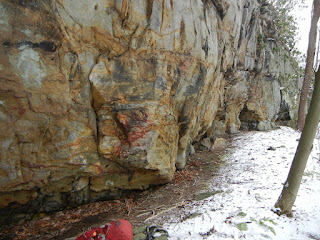
I took a hike into a seldom climbed area named Rattlesnake Rocks. It's in the vicinity of Krahlick and Elk Rocks. Climbed mostly in the 80's by Ray Burnsworth and pals. It's a short crag that houses a fair number of climbs in the 20 to 30' range. No sport climbing here. All routes were either top roped or led trad. There are numerous moderate cracks and flake options for the aspiring trad climber. Rattlesnake Rocks got its name from the rattlesnakes that are known to frequent the area during the warmer months. I spent some time dry tooling across the base of an overhanging wall.


The left end of Rattlesnake Rocks is a great place for dry tool training


It's a great place to dry tool train with many variations and a nice flat landing. I was alone and climbed sans crampons in my mountain boots. After about an hour of bouldering and a few shots of the area I set off further across the ridge to see what I could find new. I was bushwhacking and scrambling around the hillsides. All of a sudden out of no where I stumbled into this little place.


Slabs stacked like dominos this newly discovered crag is

approximately 50' tall and has some very clean looking trad lines.

There's more crag to the right of what is visible in this photo.


The climbing looks awesome. I didn't notice any signs of previous climbers, but a few ascents may have taken place here over the years. Ed Coll, Ivan Jirak, Cal Swogar... There were a few folks that thrashed through the thickets, climbed what they could and moved on. Unfortunately many of the pioneers of the area are now deceased or have moved on leaving the history a little less than known. Either way, the routes look like a lot of fun and we're planning our first climbing visit this New Years Day. Here's a few of the plums that adorn this crag.


The first line I walked up to,

a seam system unlike many in these parts


Center section of the crag. Nice flakes and corners awaiting us


It was getting later in the day and I still had quite a hike out. I finished exploring a little and made my way to the car dreaming of the great new climbs I found. I had a great day exploring old crags and finding new. After all the time I've spent wandering the ridges and valleys of SWPA, the thing that I enjoy most is what I find next...


Not only new crags, but this is one of the things you might find in SWPA???

Thursday, July 9, 2015

Honey, We Meet Again

Honey at Sunset

When a bicycle leaves you at a loss for words, is that a good thing? With hundreds of miles now on this Honey Cyclocross demo bike, I am leaning toward yes. Because I'm not exactly itching to give it back.


Last summer I was briefly without a suitable bike for dirt and gravel. When a local unpaved ride came around, a buddy lent me her Honey Cyclocross racing bike. I wrote about that bike here, then rode the Kearsarge Klassic on it successfully. And that should have been that. But months later, even as I happily rode my own bike, memories of that CX Honey kept intruding. In my first impressions write-up I described how "different" its handling felt from anything I'd tried before. As a wannabebicycle designer, this gnawed at me. What was it about that bike?


Diverged Start

Enter geographical luck of the draw. Honey Bikes are local to me, theproject of Rob Vandermark whom I know through the Ride Studio Cafe bicycle shop andSeven Cycles. Last Fall, we had occasion to talk about the cyclocross bike I'd tried, and I struggled to articulate why I found its handling so "different."


At this time, a batch of Honey demo bikes was being prepared for the Ride Studio Cafe, and one of them was set up for me. The idea was along-term test ride and review:I would ride the bike until it became familiar, allowing me to articulate what I found so striking about its handling.In particular, we discussed how appropriate a bike like it might be for long unpaved rides, and how it compared to the 650B low trail model I was comfortable with.


Honey Cyclocross, Winter Lilac
The bike arrived just as a series of snow storms hit the Northeast, which made for some appropriate pictures of the "winter lilac" colour.


I should note here that the bicycle reviewed here is completely stock in everything from size and geometry to component group and finish. Honey bikes are not custom, but made-to-order stock bikes, available in a variety of sizes and option packages. This production method allows them to keep prices in the $2,400-4,000 range for complete bikes, and to offer quick turn-around. The bicycles are steel, with carbon fiber forks (though steel forks are also available). Models include road, utility, mixed terrain, mountain, cyclocross and more. All frames are handmade in the USA, the current series produced by Seven Cycles in Watertown, MA.


Honey Cyclocross, Winter Lilac


Honey bikes are offered in two types of finishes. The standard finishesare tone-on-tone, and so subtle that the logos and other markings are virtually invisible unless you stand inches from the bike or intentionally bump up the contrast in pictures to draw them out.For those who prefer a finish with visible logos, Honey also makes"team" finishes, where the panels and lettering contrast the main colour.


Honey Cyclocross, Winter Lilac


Like the bike I had borrowed last summer, this is a stock 52.5cm Honey Cyclocross race frame (they also have a utility cross model, but this is not it). The sizing figures on Honey bikes refer to the virtual top tube length. Because this bike was set up for me from the get-go, it fit me much better than the one I rode previously. The handlebar height and width, the stem length, and the saddle position were configured with my fit in mind. The brakes were routed right=front, the way I set up my own. When I got on the bike, everything immediately felt natural, and there is a lot to be said for this. With roadbike test rides, fit really matters.


Honey Cyclocross, Winter Lilac

The Honey was set up with a SRAM Rival group and TRP mini-v brakes. The brakes work excellently (more on that here), which was a great relief from previous experiences with cantis. And while I have a Campagnolo setup on my own bikes, I am also comfortable with SRAM levers and have no problem switching back and forth between the two systems.


Honey Cyclocross, Winter Lilac

As I see it, going with SRAM on a bicycle like this has several benefits. The main one, is that SRAM now makes it possible to use low gears with a road drivetrain and modern integrated shifters. Their new wifli system, despite the silly name, is extremely useful in that it allows for a 12-32t cassette. Paired with a 50/34t crankset, that almost gives you a 1:1 low gear, without having to do anything unconventional to the drivetrain. Unofficially, I am told that the wifli derailleur will also handle a 34t cog from a mountain or touring cassette, but I wanted to ride the bike with everything stock before trying out-of-spec configurations. As is, the SRAM Rival drivetrain has been functioning flawlessly ...which brings me to the other benefit - the value. While I love the feel of Campagnolo Chorus, I've been disappointed with their lower-end groups in the past couple of years. At the lower to mid range, I have to admit that SRAM groups feel nicer. In particular, I find Rival to be the sweet spot as far as cost to performance ratio.


Honey Cyclocross, Winter Lilac

The bike is fitted with Mavic Ksyrium Elite wheels and Continental Cyclocross Speed tires, 700Cx35mm. The tires were chosen for their versatility: The tread can handle most unpaved terrain, without slowing the bike down too much on pavement. I have found this useful.Off pavement, I feel comfortable with these tires on dirt, gravel, reasonably shallow sand and not-too-thick mud. On pavement, I do find them slower than slick road tires, but it's not too bad and I don't mind working a little harder on paved sections. These tires are also great in the rain and light snow. In bad weather, I find myself reaching for this bike.


Speaking of snow... Though I did not ride a lot over this past winter, the little riding I did was mostly on the Honey. Partly this was due to the tires: They handled unexpected patches of ice and snow on the road better than the tires on my own bikes. But partly it was also the handling. I will get more into this later, but when I got the demo Honey, fitted to my riding position, my first impression was that it felt like a toy - I was compelled to try stuff on it that I had not done on other bikes - like jumping over things and riding in snow. So I did, until eventually I crashed into a tree riding in the woods. My leg and hip were covered in bruises that took weeks to heal, but luckily the bike was fine!


Honey at Sunset

Spring took a long time arriving this year. But finally by mid-March I started putting in some proper miles. As a way of ensuring I get used to the Honey's handling, for some time I rode it exclusively: Group rides, solo rides, paved rides, dirt rides, short rides, long rides - for 3 weeks straight it was all Honey, all the time. After that, I began riding my own bikes again (skinny tire road and fat tire dirt), alternating between the Honey and them.


For some time, I marveled at the handling every time I got on this bicycle. I am going to use experiential terms here. One term that comes to mind is "hyper hip-steerable." Maybe even "rear wheel drive." That is, the bike struck me as overly sensitive to movement at the hips, to the point that it almost felt like the front end was controlled from the back. For instance, let's say I was behind a rider and wanted to pass them. On this bike, I discovered a maneuver, where I could flick my hips ever so slightly while accelerating and "slingshot" past the rider in front of me in a tight, perfectly controlled arc. Maybe that sounds crazy, or maybe this is something everyone but me has been doing all along, I can never tell. In any case, it's easy and intuitive to do on this bike.


But unless I intentionally fling it sideways, the bike has a "tracks straight" feel to it at all speeds. Even when walking it I can feel this: Using the gentlest touch, I can easily steer it by the back of the saddle and the front won't turn or flop to the side. Riding it at excruciatingly slow speeds is easy as well; it really "wants to stay upright" and go straight.


Honey at Sunset

Hopping over bumps, rocks and roots is unusually easy. The first time it happened, I simply saw a huge root in front of me, and before I knew it my front wheel was sailing over it and landing on the other side. I was not conscious of having pulled up on the handlebars. I can now hop over objects on other bikes too, but it takes more effort.


On descents, initially I found that I could not easily turn and maneuver this bike using the same approach as on others I've ridden. But I quickly learned that changing my balance over the saddle made it controllable in these situations. I still do not understand this part entirely, but my subjective feel is that I almost hang off the bike to the side in order to steer it on turns. Possibly, this is my way of compensating for not being able to lean the bike itself sufficiently.


All the characteristics described become less noticeable the more I ride the bike. But if I go even as much as a week without riding it, I immediately notice them again when switching from my own bicycles. It's not a matter of better or worse, but just a "Hey, this is different!" kind of feeling every time.


Honey at Sunset

The aesthetics of the Honey Cyclocross bike are modern and sporty: thick tubes, unabashedly sloping top tube, straight fork. This look is growing on me - or maybe a more accurate way to put it would be "I appreciate it for what it is." I do love the winter lilac finish.The welds are very smooth, more or less invisible under the paint. And the overall look has a unity and harmony to it that makes sense to me visually.


The tubing is oversized and thin-walled. Pinging it with my fingernail, there is a distinct hollow ring. Riding the bike, it feels extremely stiff - though not in a disagreeable way. It feels light in motion, fast to accelerate, ever-ready and ever-awake. Despite the stiffness, the ride is not harsh. The jury is still out on the relationship between flex and responsiveness to pedaling effort, and I won't attempt to make any connection here. I will only say that I enjoy how stiff this bike feels.


I intentionally did not look at the geometry in advance, so as not to bias my impressions. When I did have a look later, I did not see anything too unusual. Longer chainstays and less bottom bracket drop than typical with road geometry; slightly higher trail. None of it seemed sufficiently dramatic to explain my strong reaction to the bike. Maybe it's one of those "the whole is greater than the sum of its parts" things. There is, after all, a lot I don't understand about bicycle design.


Honey at Sunset

The one word I would use to describe the Honey Cyclocross bike is "fun." As in exciting, playful, toy-like. This bike really moves, and under a more skillful rider than me I am sure it would move even better. While I am obviously not evaluating it in that context, I can see how a bike like this would make a good choice for racing cyclocross.


As far as unpaved brevets and such, I think the CX Honey could work nicely for those who want a lightweight, modern, racy bike with wide 700C tires. Although designed for short races, to me it feels great over 100K distances. The main thing, is that after hours in the saddle I find it delightfully non-fatiguing.


Not being a utility bike; this particular Honey model is not built for racks or carrying heavy loads. Riding it with a full, wide Carradice-style saddlebag in the rear, I can feel the weight (or drag - not sure which). With a smaller bag that tucks under the saddle (like the Dill Pickle shown here) this is considerably less pronounced. I have not tried a bag on the front - though I've now been lent an Ortlieb system to experiment with, and will report back.


Honey at Sunset

Riding this bike on dirt and gravel, I am as fast as I'm capable of being,and reasonably confident riding over most types of terrain I encounter. On pavement, I am slower on the Honey than on my skinny-tire roadbike. And compared to my low trail 650Bx42mm all-steel bike, the Honey is on average about the same both on pavement and dirt. One aspect where they differ, is if I try to seriously push the speed beyond my comfort zone - for instance, in order to keep up with faster riders. When doing this, I can push both bikes pretty hard, but on the Honey I feel less tired afterward. The 5lb difference in the weight of the bikes could account for this, as could the difference in frame and fork materials. On the other hand, when all is said and done I prefer my own bike's front-end handling. It is simply more intuitive to me, and on challenging terrain with twists and turns I am generally more relaxed and precise on it for that reason. Nonetheless, I appreciate the Honey's handling as well. I especially enjoy switching between the bikes and experiencing the difference, adapting to one then another.


It fascinates me to no end how two bikes can excel at the same task, yet ride and feel so differently.I will elaborate on this shortly, but recently I began working with Rob Vandermark on a special project. My experience with the CX Honey - in conjunction with my own bike - has been particularly educational in that context.


With unpaved riding increasingly popular, it's exciting to have choices for go-fast bikes with fat tires. The Honey Cyclocross bike is certainly worth considering - fast, fun, made in Massachusetts, and reasonably priced with lots of sizing options. It's been a pleasure getting to know this bicycle, improving my handling skills and expanding my horizons in the process.