All week long people have been apologising for the weather. It's been raining severely for at least a portion of every day that I've been here. But the thing is, I really don't mind. And it is certainly not ruining my stay here.
Consider, for instance, that some of the most dramatic scenery emerges in bad weather. The gathering of storm clouds. The mist rising over the glens. The waves crashing onto rocky shores. Tall grass windswept. These things cannot be captured - or seen, for that matter - without this so-called "bad" weather.In the rain, colours look brighter, more saturated. The smell of flowers grows more intense, Textures come out that are not otherwise visible.
In bad weather, you get to know a place better. Any spot can look charming in the sunshine and under blue skies. But how will it look in the rain and under the shadow of storm clouds? Some places are rather depressing as soon as the weather turns bad; others are breathtakingly romantic.
They say rain is good for your complexion, that it makes your skin radiant and restores elasticity. Just think: Every time you are out in the rain, you are really getting a beauty treatment.
In the rain the country roads are mostly empty - ideal for cycling in peace and tranquility while enjoying views unobscured by cars and tourists.
It's a clichéto say there is no such thing as bad weather, and I don't really believe that anyway. There are tornados, hurricanes, lightning storms, blizzards. But some heavy rain? I get my camera, check my brakes, wear waterproof clothing, turn my lights on, protect my equipment inside a bicycle bag, and enjoy the ride. No need to apologise, Ireland - the weather is lovely!

 Many of the shops in Old Town were first residents, some over 200 years old. There are still people that live over their shops or behind them.


 Blue window frame with a huge dark pink crape myrtle blooming beside it.


 Living the life in gorgeous North Carolina!
 Sometimes I get emails where ladies send me pictures of their bicycle and ask whether I think "it would look better" with dress guards and/or a chaincase. Ladies... You do realise that these things are not there for the looks, right? Although a set of dress guards and a chaincasedo lend a certain charm to a bicycle, aesthetics are not their primary purpose. So let me explain why I put them on my bikes, and then you can decide for yourself whether you need them or not.
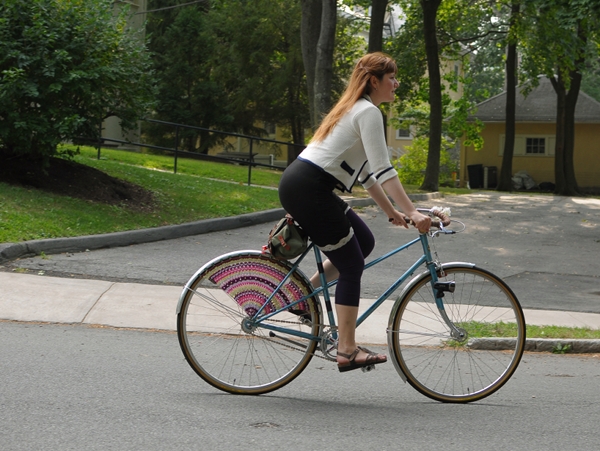 The purpose of dress guards is to stop fluttery, loose clothing from flying into the spokes of your rear wheel and either getting ruined or causing an accident.The main determinant of whether you need dressguards is whether you wearthe sort of clothing that requires their protection - for instance: flared skirts, dresses, long coats, or flowing tunics. Once you have had something get stuck in your rear spokes or have seen it happen to someone else, you know that the possibility is real and that it can even cause injury. Personally,I will not ride a bicycle without dress guards if an article of clothing I am wearing is long enough to reach the rear spokes. And since much of my everyday clothing is in that category, it is a good idea for me to install dress guards on any bike I plan to use for transportation.
 I have also been asked what kind of dressguards are better: netted or solid. There are probably differing opinions on this, but in my experience it does not matter. My vintage Raleigh(above) is fitted with very minimal dressguards that are basically just stretchy cords fanning out from the rear dropouts. For me, this has been sufficient; the cords - closely spaced - provide a perfectly functional barrier.The obvious advantage to dress guards that are woven, is that they are lighter (and usually more attractive) than plastic ones. The disadvantage is that they can be more expensive and more difficult to clean.
 Moving on to chaincases, their purpose is two-fold: (1) to prevent the bottoms of your trousers from being caught in the chain, and (2) to keep the chain clean from street grime, especially in bad weather. Since I seldom wear long trousers, the first function is not that important to me. So while I do appreciate that the chaincase keeps my chain nice and clean, this accessory is not as crucial for me as dress guards, because it is a maintenance feature rather than a safety feature. I can still ride a bike without a chaincase for transportation.
 Furthermore, while I have found dress guards to be effective in preventing clothing from getting stuck in the spokes, I have not found chaincases to be entirely effective on those rare occasions when I do wear trousers. A couple of times, the bottoms of my trousers have actually gotten stuck on the chaincase itself, which has only increased my bias for skirts once I started cycling. Don't get me wrong, I still love a nice, elegant chaincase. But I admit that this feature does not hold as much functional purpose for me as do dress guards.
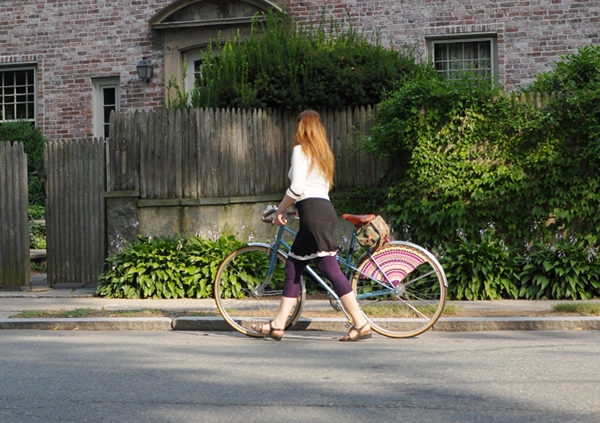 Dress guards and chaincases are not affectations, but necessary accessories for transportation in everyday clothing. As the popularity of "city bikes" rises, I hope that more American bicycle shops will realise this, and start carrying these useful items.


 I've finally had the "where's my bike??" moment of panic a couple of nights ago. I'd left Jacqueline chained to one of the bike racks at the huge intersection in the Museumsquartier and went out for dinner with a friend.
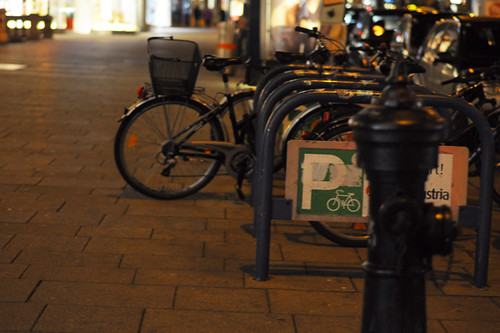 Afterward, I went to retrieve the bike, but was horrified not to see it at the rack where I remembered leaving it.
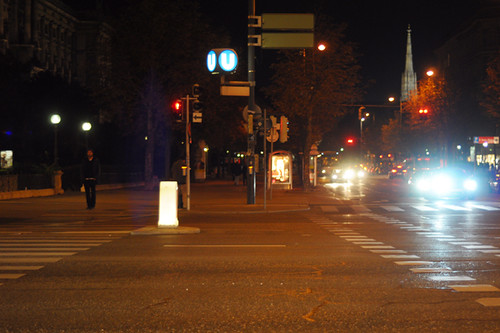 This is a large, busy intersection that has between one and three bicycle racks on each corner. It was possible I'd left it on a different rack from the one I remembered. I started checking them all, with my friend's cheerful encouragement: "Relax, no one wants to steal your junky bike!"
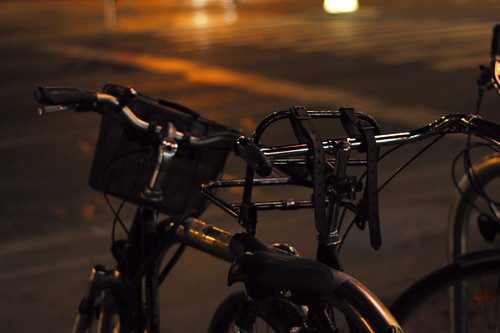 While I don't appreciate the implication that Jacqueline is undesirable, I am glad that she was indeed safely locked up to a bike rack down the road. The shape is so recognisable, that I spotted her as soon as we approached. Immensely relieved, I vowed to pay more attention to where I leave her.
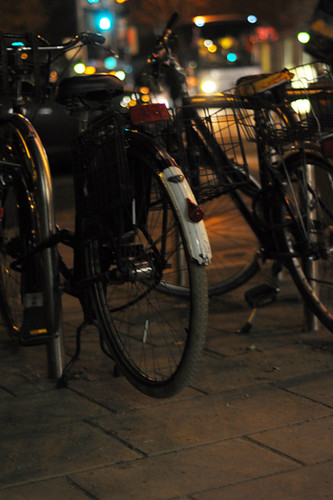 On a separate note, the headlight bracket on Jacqueline snapped over the weekend (you can see it positioned at an odd angle here), and we do not have a replacement. So we've removed the headlight altogether now and I am using the LED battery-operated lights I brought with me from the US. Cycling with those at night, a couple of times now local cyclists have commented that my tail light is too bright. It's not that it blinds them, but more like they just find it disconcerting - not typically associating that level of brightness with a bicycle. Interesting, because in Boston the same tail light is not considered too bright at all; in fact in the past I've used two of them whereas here I am only using one. Just goes to show how different cycling "culture" can be, even in terms of light intensity preferences.